



For generations, mathematics has been confined to classrooms, homework assignments, and examinations. Ask most adults about their memories of math, and they’ll likely describe report cards, formulas, and the pressure of getting the right answer. Rarely will they talk about excitement, performance, or celebration.
Yet mathematics is far more than a school subject.
Students who regularly engage with mathematical challenges learn how to break down complexity, evaluate different approaches, identify patterns, and make reasoned decisions under pressure.
It is the language of innovation, the foundation of technology, and one of the most powerful tools for solving real-world problems. Every breakthrough in artificial intelligence, space exploration, medicine, finance, and engineering is built on mathematical thinking. More importantly, mathematics teaches children how to reason logically, recognise patterns, think critically, and solve problems – skills that remain valuable regardless of the career they choose.
The question, then, is not whether mathematics is important.
The question is: why don’t we celebrate mathematical talent the way we celebrate every other talent?
Every year, millions of Indians tune in to watch children sing, dance, cook, play sports, or showcase artistic talent on national platforms. These competitions have done something remarkable – they’ve transformed hobbies into aspirations. They have shown children that talent deserves recognition and that excellence can inspire an entire country.
But when it comes to mathematics, that same stage has largely been missing.
Across every school in India are students who instinctively recognise patterns, solve complex problems with remarkable speed, and genuinely enjoy the challenge of numbers. Their abilities are every bit as extraordinary as those of a gifted musician, athlete, or performer. Yet those talents often remain hidden inside classrooms, visible only through examination scores or report cards.
Imagine if mathematics were presented differently.
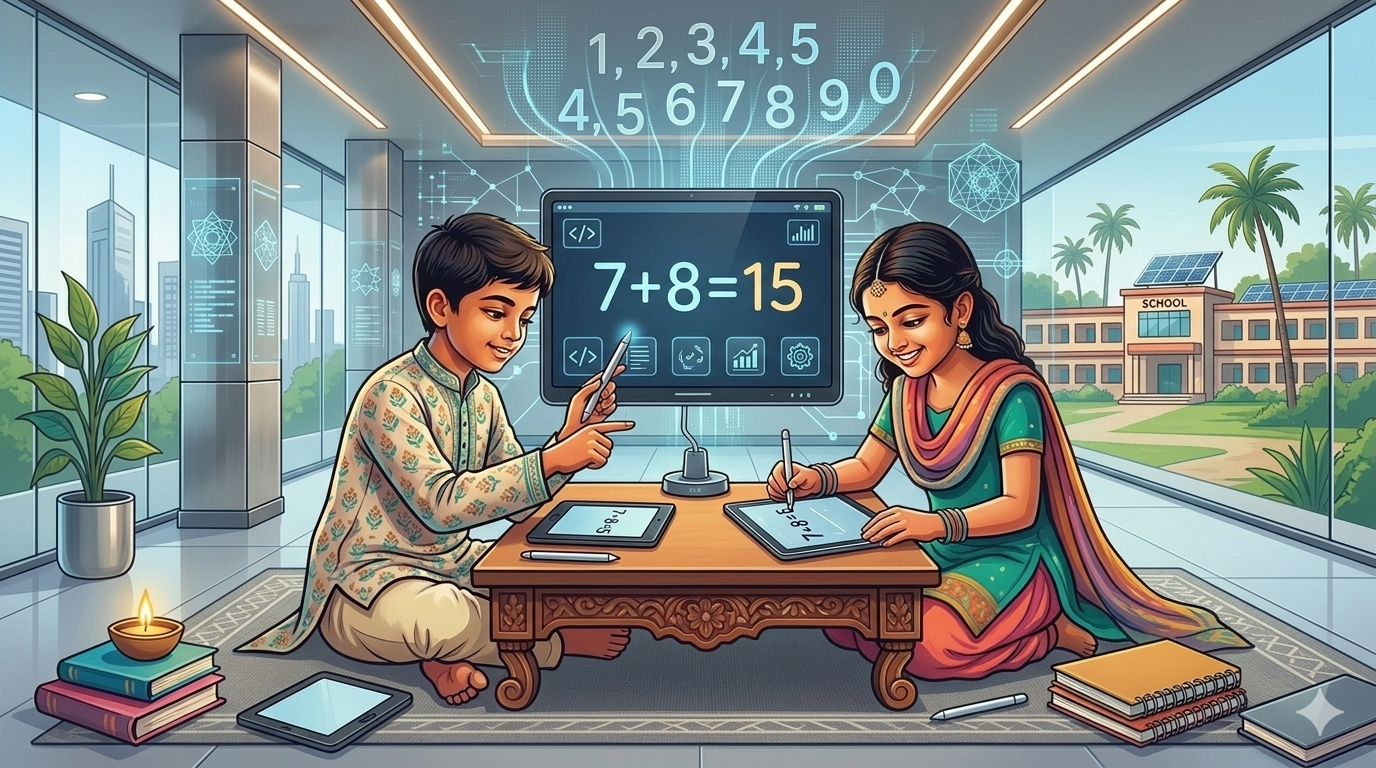
Imagine students solving fast-paced logic challenges before a live audience. Imagine visual puzzles, timed rounds, strategic thinking, and real-time leaderboards. Imagine families discussing clever solutions over dinner the way they discuss quiz shows or sporting events. Imagine young mathematicians becoming role models for other children.
Mathematics has every ingredient required to become engaging and entertaining. The challenge has never been the subject itself – it has been the way we’ve traditionally presented it.
A well-designed mathematics competition changes this perception entirely.
Unlike conventional examinations that often reward memorisation and procedural accuracy, competitions encourage exploration, creativity, and problem-solving. Students are presented with unfamiliar situations where there isn’t always an obvious path to the answer. They learn to analyse, adapt, and think independently.
In that environment, mathematics stops feeling like a subject to complete and starts feeling like a challenge to conquer.
This shift is incredibly powerful.
Instead of asking, “Will this be on the exam?”, students begin asking, “Can I solve this another way?”
That curiosity is where meaningful learning begins.
Another common misconception is that mathematics competitions are only meant for exceptional students. In reality, every child can benefit from the experience of participating.
For advanced learners, competitions provide an opportunity to stretch beyond the school curriculum and tackle problems that reward creativity rather than repetition. They discover that mathematics is an evolving discipline where multiple approaches can lead to elegant solutions.
For students who may not yet see themselves as “good at math,” competitions offer something equally valuable – confidence. Solving even one challenging problem independently creates a sense of achievement that traditional classroom assessments often fail to provide. Participation teaches children that success in mathematics is built on persistence, experimentation, and logical thinking rather than innate talent alone.
In many ways, the greatest lesson isn’t learning mathematics – it’s learning how to approach difficult problems without giving up.
These experiences become even more relevant in the world today’s students are preparing to enter.
Artificial intelligence, robotics, data science, biotechnology, and climate innovation are transforming industries at an unprecedented pace. While technology will continue to evolve, one skill will remain timeless: the ability to think critically and solve unfamiliar problems.
Mathematics develops exactly that mindset.
Students who regularly engage with mathematical challenges learn how to break down complexity, evaluate different approaches, identify patterns, and make reasoned decisions under pressure. These are not simply academic abilities – they are life skills that will serve them whether they become engineers, doctors, entrepreneurs, designers, researchers, policymakers, or leaders.
Perhaps equally important is the cultural shift that mathematics competitions can inspire.
For decades, extracurricular excellence has been celebrated through national platforms. Music competitions have inspired aspiring singers. Dance reality shows have encouraged countless performers. Sporting tournaments have motivated young athletes to dream bigger.
These platforms do more than identify talent – they change how society values it.
Mathematics deserves that same opportunity.
When intellectual achievement is celebrated publicly, it sends a powerful message to children: thinking deeply is something to be proud of. Logical reasoning deserves applause. Curiosity is worth celebrating. Excellence isn’t limited to the playing field or the stage – it can also be found in the classroom and beyond.
Imagine a future where a difficult math puzzle sparks conversations at the dinner table. Where schools proudly cheer for students representing them in mathematics just as they do in sports. Where children look forward to solving problems with the same enthusiasm they bring to other competitions.
That future is entirely possible.
Ultimately, the value of a mathematics competition isn’t determined by who finishes first. It lies in giving every child the opportunity to challenge themselves, think differently, and discover the joy of solving problems.
Not every participant will stand on a podium. Not every student will win a medal.
But every child who participates learns something invaluable: that difficult problems can be solved, that persistence matters, and that intellectual curiosity is worth pursuing.
As education continues to evolve, schools must prepare students for much more than examinations. They must nurture resilience, creativity, collaboration, and critical thinking. Mathematics competitions complement classroom learning by creating environments where these qualities naturally flourish.
For too long, we’ve celebrated children for how beautifully they can sing, dance, paint, or play.
Perhaps it’s time we celebrated them for how brilliantly they can think.
Because when mathematics moves beyond textbooks and examinations to become something children perform in, compete in, and aspire towards, we don’t just create better mathematicians.
We create a generation of confident problem-solvers, curious learners, and innovative thinkers – qualities that will shape the future of our society far beyond the classroom.

Guest author Neelakantha Bhanu is the Founder of Bhanzu, a global math learning platform. Any opinions expressed in this article are strictly those of the author.