


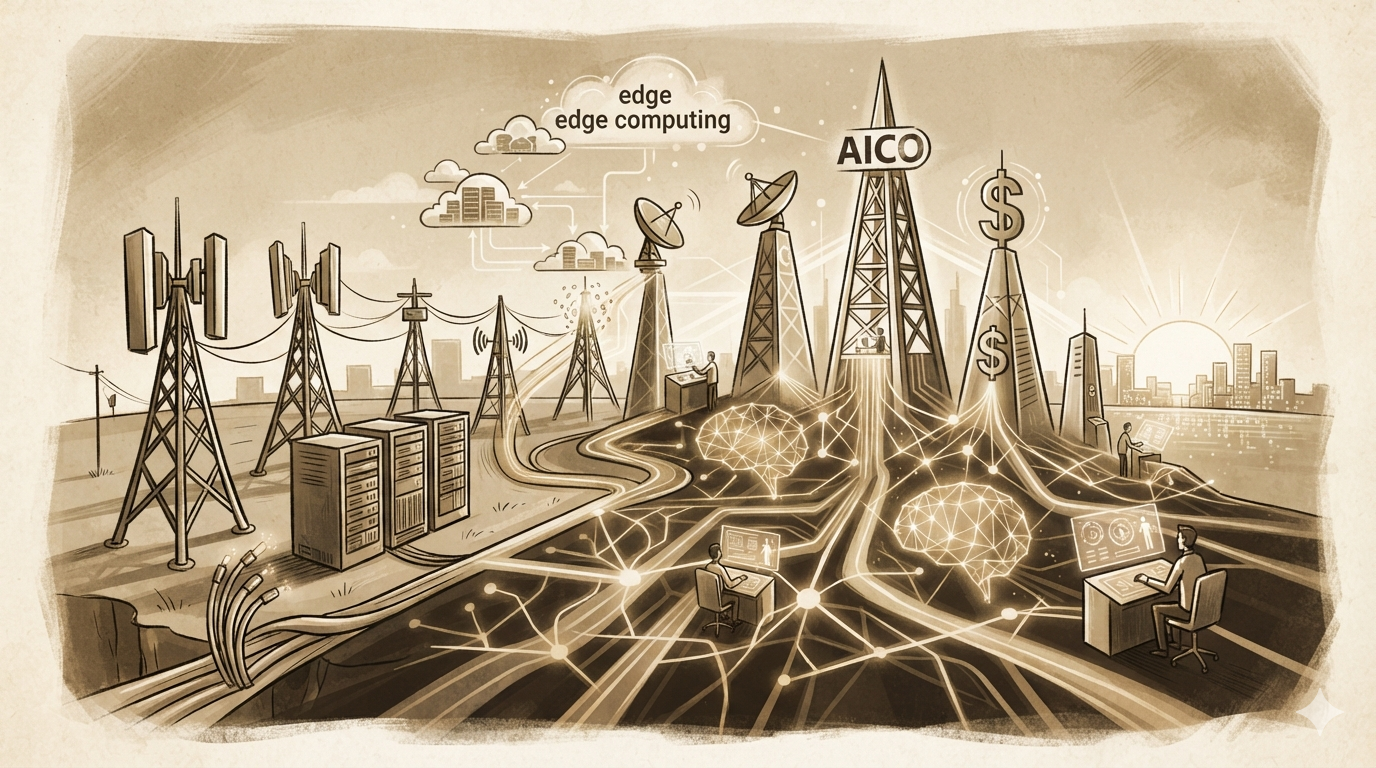


The telecommunications sector is facing a defining strategic turning point. As edge computing and real-time inference applications explode, telecom operators are aggressively fighting a critical battle, move beyond traditional connectivity models or risk being commoditized into “dumb pipes” by cloud giants like Microsoft, Google, and AWS. To capture the profitable apex of the AI value chain, the industry is transitioning into an Autonomous “AICO” (AI Infrastructure Company) model, rearchitecting networks from the core to the customer edge.
The telecommunications sector has come to a place where traditional connectivity is no longer enough to sustain long-term growth. To avoid being marginalized into mere utility providers by aggressive hyperscalers, operators must fully commit to the transition toward AICOs.
The velocity of this shift is backed by hard numbers. According to NVIDIA’s 2026 State of AI in Telecommunications report, 89% of telcos plan to boost AI spending this year, while 77% expect to deploy fully AI-native networks before 6G even arrives.
From Chatbots to Agentic AI Operations
This infrastructure revolution is drastically changing internal operational expenditures (OPEX) and capital allocation (CAPEX). Operations are rapidly shifting from basic conversational chatbots to Agentic AI, systems that actively observe, decide, and execute autonomous tasks without human intervention. Carriers like AT&T and Telefónica are already deploying autonomous multi-agent systems for predictive maintenance and automated field-force scheduling.
Similarly, network architectures are transforming into self-healing, self-scaling systems. Enterprise partners like HCLTech are accelerating this shift by deploying Augmented Network Automation (ANA) platforms alongside machine-learning intent frameworks. By dynamically predicting traffic and automating Radio Access Network (RAN) resource allocation, these systems cut energy consumption while driving a 10% to 15% optimization across both CAPEX and OPEX budgets.
Commercializing the Edge: Sovereign AI & Network APIs
Beyond internal efficiencies, telcos are unlocking new, high-value enterprise revenue streams by offering secure, localized AI workloads. A prime example is Singtel, which launched RE:AI, a dedicated GPU-as-a-Service (GPUaaS) platform functioning as a “Sovereign AI Factory” for Southeast Asia. By pairing local data centers with on-demand NVIDIA H100 clusters, Singtel ensures highly sensitive enterprise data never crosses national borders.
Simultaneously, operators are shifting network capabilities into open, monetizable developer ecosystems. Through platforms like Deutsche Telekom’s MagentaBusiness API (powered by Ericsson’s Vonage), enterprises can consume network capabilities, like real-time, silent SIM authentication and on-demand quality-of-service (QoS) bandwidth, on a per-transaction basis.
Concurrently, SoftBank recently unveiled its “Telco AI Cloud” vision. Powered by its proprietary Infrinia AI Cloud OS, SoftBank integrates large-scale GPU data centers with edge AI-RAN to target “Physical AI”, offloading heavy compute models from industrial robots and factory-floor automation systems via ultra-low latency cellular links.
The Ultimate Edge: The Battle for Space Spectrum
To drive communication delays down even further, the frontier of AI connectivity has extended into space. The Very Low Earth Orbit (VLEO) and Low Earth Orbit (LEO) satellite markets are becoming the ultimate competitive layer for real-time edge processing.
A massive validation of this strategy occurred when Amazon acquired Globalstar in an $11.57 billion deal to supercharge its satellite division, newly rebranded as Amazon Leo.
“There are billions of customers out there operating beyond the reach of existing networks, and we started Amazon Leo to help bridge that divide,” noted Panos Panay, Amazon’s Senior Vice President of Devices, Alexa, and Leo.
The merger allows Amazon Leo to inherit Globalstar’s vital wireless spectrum, power critical emergency Direct-to-Device (D2D) services for Apple iOS devices, and create a unified global telecom footprint.
However, even multibillion-dollar space strategies face immediate terrestrial realities. According to Reuters, while the acquisition secures irreplaceable spectrum, it does little to immediately fix Amazon’s massive satellite count disparity. With Globalstar adding fewer than 250 operational satellites to Amazon’s early fleet, the e-commerce giant remains bottle-necked by a severe rocket launch deficit as it attempts to catch up to Elon Musk’s dominant Starlink network of over 10,000 satellites.
The Architectural Shift
The telecommunications sector has come to a place where traditional connectivity is no longer enough to sustain long-term growth. To avoid being marginalized into mere utility providers by aggressive hyperscalers, operators must fully commit to the transition toward AICOs.
As demonstrated by pioneers like SoftBank, Singtel, and Deutsche Telekom, the path forward lies in monetizing premium edge infrastructure, exposing network capabilities through profitable APIs, and embedding agentic AI into core operations. While high-stakes satellite consolidation, such as Amazon’s acquisition of Globalstar, highlights the intense battle over global spectrum, the true winners of this era will be the operators who successfully convert their physical footprints into secure, sovereign AI engines. Telcos that successfully navigate this architectural shift will secure a highly lucrative position at the foundation of the next-generation digital economy.