


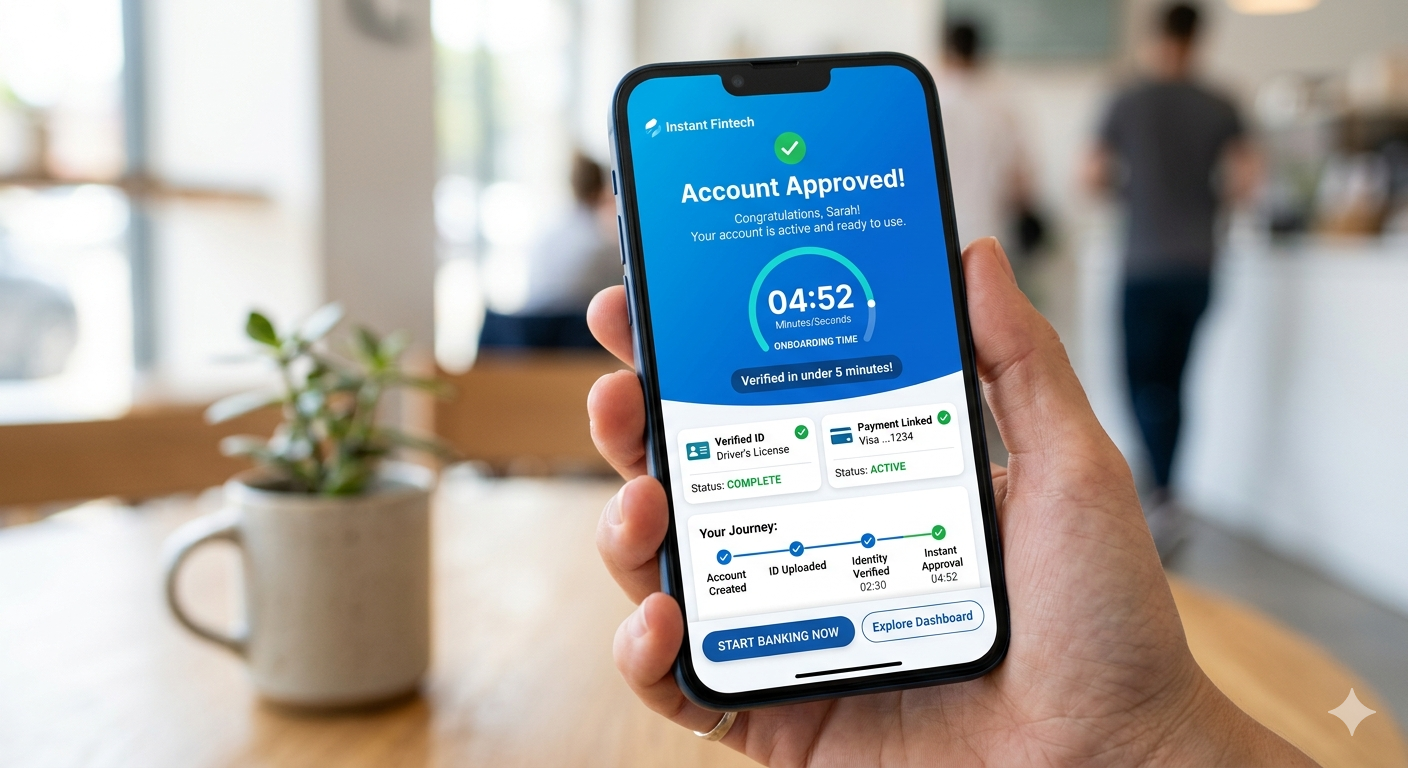


I remember when three days felt like a perfectly reasonable wait to open an account. We even called it diligence. Now it feels like an apology nobody bothered to give — and the customer doesn’t wait around for it. They quietly move to whichever provider lets them snap a selfie, sign on screen, and hear “you’re in” before their tea cools down.
Speed is the first step in the customer journey. If it’s slow, customers won’t stay.
Our team has sat across the table with compliance heads, retail heads, and CTOs at banks and NBFCs who all say some version of the same thing in the first meeting: “We know onboarding is slow. We just didn’t know it was costing us this much.” Speed is the first step in the customer journey. If it’s slow, customers won’t stay.
The Hidden Cost of Slow Customer Onboarding
A 2025 industry survey of senior decision-makers across banks, asset managers, and fund administrators found that a record 70 percent of financial institutions lost clients in the past year because of slow onboarding — up from 67 percent in 2024 and 48 percent in 2023. That’s a trend line pointing straight up.
The consumer-side data is just as stark. Industry research puts digital onboarding abandonment in financial services between 60 and 80 percent, with financial and crypto platforms seeing the highest rates due to complex KYC requirements. Separate analysis has found the average consumer walks away from a financial application after roughly 19 minutes.
We’ve seen this up close. Across onboarding journeys we’ve built for lenders and insurers, the biggest predictor of drop-off isn’t how many documents a customer submits — it’s how many times they’re asked to wait between steps. Sequential verification, where a customer submits something and then sits idle while it’s checked, is where most institutions bleed applicants. When checks run in parallel instead, completion rates climb noticeably, often within weeks of launch.
Multi-page forms, branch visits, manual document checks, and “we’ll get back to you in 48 hours” have quietly become leading causes of customer attrition — not fraud, not credit risk, not pricing. Simply friction.
Slow onboarding isn’t cautious. It’s expensive procrastination wearing a compliance badge.
Institutions have historically treated lengthy onboarding as the price of safety — a trade-off between speed and risk. In our experience, that trade-off is rarely a technology gap; it’s an organizational one. Risk and product teams are often still solving for last decade’s fraud patterns using this decade’s customer patience. The technology to be both fast and secure already exists; choosing one over the other now means losing customers to whoever figured out how to have both.
What’s Making Five-Minute Onboarding Possible
From what we’ve seen while working with clients, fast onboarding relies on a few simple technologies working together. Live video and AI-based identity checks confirm the customer is real within seconds. Smart document processing reads and fills in details automatically while spotting errors early. Watchlist and sanctions checks run in the background. Digital signatures complete the process instantly. API-first platforms connect everything, making it easy to add or replace features without rebuilding the entire system.
The institutions that get this right haven’t simply hired faster people — they’ve stopped asking humans to do work a well-designed system does more reliably. The harder, more useful question for a CEO isn’t “which vendor does verification best.” It’s “which three minutes of our onboarding journey exist only because we’ve never questioned them?” That’s usually where the real gains hide, and it’s rarely a pure technology answer — it’s also a governance question about who inside the institution owns that journey end to end.
Automation Strengthens Compliance, It Doesn’t Weaken It
This surprises many executives the first time they see it in action. Manual review is inconsistent by nature — different analysts, different days, different judgment calls. Automated onboarding applies the same rigorous check every time, logged and auditable, so when a regulator comes asking, the institution exports a report instead of scrambling through filing cabinets.
This isn’t theoretical. Industry estimates put the average cost of financial crime compliance operations at nearly $73 million per firm — a number that keeps climbing even as institutions add headcount, a strong signal that “more analysts” doesn’t scale. In India, the RBI’s forthcoming CKYC 2.0 rollout is expected to push institutions toward faster, safer, automated onboarding, and firms cleaning up data and modernizing workflows now are the ones likely to migrate smoothly rather than scramble later.
What we’ve seen with our clients is simple. When teams stop chasing documents manually, they spend more time on complex cases that need human judgment. This improves efficiency without adding more people.
The New Standard for Customer Onboarding
Customers no longer compare your onboarding to your closest competitor — they compare it to the last app they used, regardless of industry. Research on customer journey transformation in banking backs this directly: fee transparency, ease of communication, and the ability to track onboarding status together account for 42 percent of overall customer satisfaction. Some banks deploying re-engagement nudges for customers who abandon mid-application have reported completion-rate gains of 10 to 20 percent from that single intervention alone.
In our experience, the fastest-moving institutions aren’t the ones with the biggest budgets. They’re the ones where the CEO treats onboarding speed as a business priority, not just an IT project.
What’s Next for Digital Onboarding
Five-minute onboarding won’t stand out for much longer. It is quickly becoming what customers expect. Regulators are making identity verification faster with initiatives like CKYC 2.0. At the same time, businesses are investing more in digital identity solutions, showing this is a long-term change. The focus is also shifting from checking a customer only at onboarding to monitoring risk throughout the customer relationship.
The winners will be the institutions that make onboarding speed a strategic priority today. Everyone else will spend the next few years explaining why their process is still slow.

Guest author Shyam Arora is the CEO of Meon Technologies, a modern SaaS company transforming how businesses onboard, verify, and engage customers. Any opinions expressed in this article are strictly those of the author.