


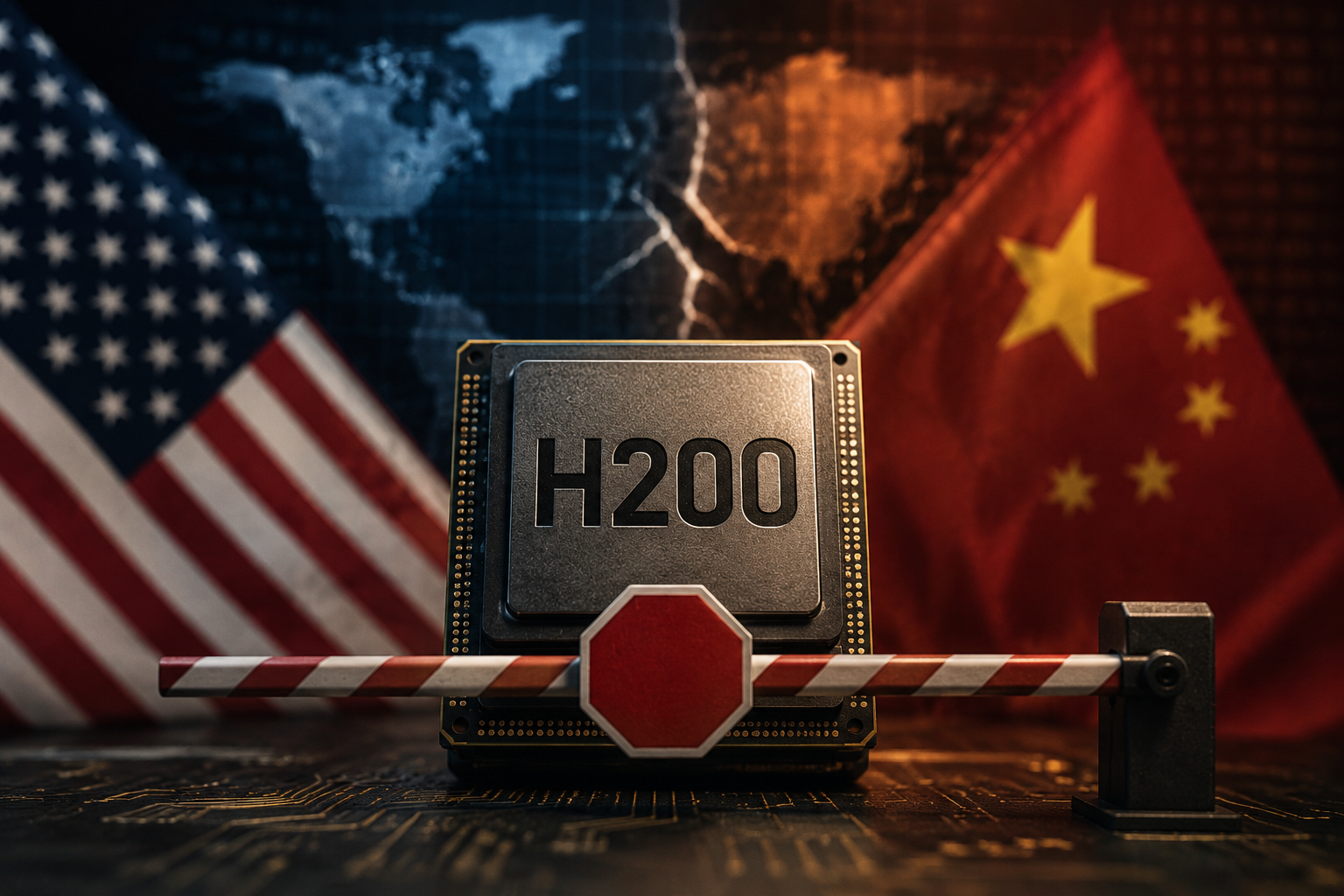


In the global race for artificial intelligence dominance, semiconductors have become leverage. The ongoing standoff over Nvidia’s H200 AI chips reveals how deeply politics now shapes access to cutting-edge technology. While Washington has cautiously reopened the door for exports, Beijing is selectively tightening its grip, balancing immediate AI demand with long-term ambitions for self-reliance.
Innovation may still be global, but access is becoming regional and conditional
Caught in between are companies like ByteDance, Alibaba, and Tencent, global players navigating a fragmented system where access to critical infrastructure depends less on market forces and more on national strategy. What emerges is a supply chain disruption and a redefinition of how technology flows across borders.
The situation surrounding Nvidia’s H200 AI chips centers on an intense regulatory tug-of-war between the US and China, leaving billions of dollars in hardware orders frozen in political limbo. While the US has conditionally greenlit the chips, Beijing is blocking them from entering the country to protect its domestic chip industry.
Read more: AI & Job Loss in Emerging Markets: Fewer Entry Jobs, Higher Skills, Bigger Stakes
In January, as per Reuters, China gave the nod to three of its largest tech companies to buy Nvidia’s H200 artificial intelligence chips, ByteDance, Alibaba and Tencent. This marked a shift in position as Beijing seeks to balance its AI needs against spurring domestic development.
Earlier, China’s customs agents said Nvidia’s H200 chips are not permitted to enter the country. Elsewhere, Beijing told Chinese firms to stop using US and Israeli cybersecurity software.
Nvidia asked for full upfront payment from Chinese customers seeking its H200 artificial intelligence chips, hedging it against ongoing uncertainty over Beijing’s approval of the shipments.
For companies like Nvidia, more than scaling production to meet demand, the challenge is navigating a world where every shipment carries political weight.
In August, President Trump announced a proposed 100% tariff on imported semiconductors, designed to boost US manufacturing, but with a significant exemption. Companies either already making chips in the US or promising to do so, like Apple, Nvidia, and TSMC, would be excluded from the levy, aiming to incentivize bringing semiconductor production back to America.
However, towards the end of last year, Nvidia was telling Chinese clients that it is looking to add production capacity for its powerful H200 AI chips since orders have exceeded its current output level. The move came after Trump said the US will let Nvidia export H200 processors to China while it collected a 25% fee on such sales.
Allowing Nvidia to sell its top chips to China is a win for the company and the stock market, but undercuts Trump’s vows to defeat China in what he sees as an AI arms race. The White House’s recent decision to allow sales if the government gets a cut reverses a decade of policy.
In September, China stepped up to wean the country off Nvidia hardware and boost domestic alternatives, amid ongoing trade talks between Washington and Beijing, when US export curbs were effectively barring Chinese firms from buying advanced foreign chips and manufacturing gear. China started instructing companies including Alibaba Group Holding Ltd. to halt Nvidia orders for their RTX Pro 6000D, a semiconductor for workstations that can be repurposed for AI applications. That same month, Alibaba announced a partnership with Nvidia, global data center expansion plans and new AI products positioned alongside its traditional e-commerce operation.
Companies like Nvidia and ByteDance are becoming pawns in today’s digital wars. Both are being squeezed on national security grounds in exchange for access to two lucrative markets.
It’s worth remembering that opening the Chinese market to US firms was one of Trump’s goals since the trade war of 2017-2021. Eight years on, the market shows few signs of being more open, especially for top AI firms. Meanwhile, the US is borrowing from Beijing’s state-capitalist playbook, using rules and legislation to decide who can sell tech in China and what US tech can be sold abroad.
AI is no longer governed by open markets, but by controlled corridors of access shaped by policy, tariffs, and strategic concessions. The US, once a champion of free-market technology expansion, is increasingly adopting tools of economic statecraft, mirroring tactics long associated with Beijing.
Read more: Work or Be Rewritten: How AI is Reshaping Jobs, Hiring & Power at Work
For companies like Nvidia, more than scaling production to meet demand, the challenge is navigating a world where every shipment carries political weight. For China, the push to restrict and replace foreign technology signals a deeper commitment to technological sovereignty, even at the cost of short-term capability gaps.
What this moment reveals is a new reality for the global tech industry, innovation may still be global, but access is becoming regional and conditional. In this environment, while powering AI systems, chips are also defining the rules of engagement in an emerging digital order.